
Reviewed · PORT LOUIS TOURS
ROUTE OF INDIAN SPIRITUALITY
Sacred stories make Mauritius feel closer. This three-hour private outing links three important temples in northern Mauritius with Hindu and Tamil traditions, local history, slavery, and modern Maurian life. I like the clear focus on meaning rather than quick photo stops, and I like that guide Eric explains questions such as why Shiva has a blue neck and why a lingam is continually watered. The tour costs $64.61 per person, a fair price for a private experience with a specialist subject.
I also like the chance to connect temple visits with festivals such as Maha Shivaratree, Cavadee, Ganesh Chaturti, Ganga Snan, and Govinden. The main consideration is that this is an interpretive tour, not a broad sightseeing trip. You spend most of the time around religious sites in the north, and festival processions or prayers are available only on specific dates.
In This Review
- Key points at a glance
- Why this temple tour is worth your morning
- Triolet and the first Maha Shivaratree pilgrimage
- Cap Malheureux and the first Tamil kovil
- The 15-meter Muruga statue
- Festivals that give the route its wider meaning
- Eric’s guiding style and the value of a private group
- Price, timing, and practical fit
- Who should book this experience
- Should you book Route of Indian Spirituality?
- FAQ
- Where does the tour start?
- What time does the experience begin?
- Where does the tour end?
- How long does the tour last?
- How much does the experience cost?
- Is this a private tour?
- Which temples are included?
- Are admission fees included?
- Can I attend a religious procession or prayer?
- What happens if bad weather cancels the tour?
Key points at a glance
- Three temples, three different focuses: Visit the temple at Triolet, a Tamil kovil at Cap Malheureux, and a second Cap Malheureux temple with a 15-meter Muruga statue.
- A strong history lesson: The tour connects Indian spirituality in Mauritius with slavery, migration, local society, and present-day religious practice.
- Questions are welcome: Learn the stories behind Shiva’s blue neck, the broken tusk of Ganesh, and the constant watering of the lingam.
- Private for your group: You do not share the activity with other participants, which should make sensitive questions easier to ask.
- A useful festival connection: The guide explains Maha Shivaratree, Cavadee, Ganesh Chaturti, Ganga Snan, and Govinden, with processions or prayers offered on suitable festival dates.
- Simple northern-Mauritius logistics: Meet at La CroisetteMU in Grand Baie at 9:00 a.m., then return to the same point.
Why this temple tour is worth your morning
Mauritius is often sold through beaches, lagoons, and resorts. Those are real pleasures, but they tell only part of the island’s story. Indian religious traditions are central to Mauritian culture, and this tour gives you a direct way to understand that influence through places of worship.
I like the playful tone promised here. Religious subjects can become stiff or overly formal, but questions about Shiva’s blue neck or Ganesh’s damaged tusk give the conversation an easy starting point. The approach remains respectful while making the symbols easier to remember.
The tour also asks useful questions about identity. Are the customs Hindu, Tamil, or both? What do the festivals celebrate? How do these traditions shape Mauritian society now? You are not simply shown statues and told their names. You are encouraged to think about how religion operates in a modern island nation.
The private format matters. You travel only with your own group, so you can ask for clarification without holding up a larger party. That is especially useful if you know little about Hindu or Tamil traditions, or if you want to discuss the difference between a religious story and a local legend.
The drawback is its narrow scope. If your ideal morning includes many types of sightseeing, this may feel focused to the point of being specialized. The tour lasts about three hours, but temple visits and explanation take priority over long scenic stops.
Other days out in Port Louis that people book on the same holiday:
- Mauritius: Exclusive South West Tour
★ 4.8 · 523 reviews - Port Louis: Street Food & City Tour
★ 4.7 · 518 reviews - Mauritius North: Private Paradise Tour with Gardens, Markets
★ 4.8 · 446 reviews
Triolet and the first Maha Shivaratree pilgrimage
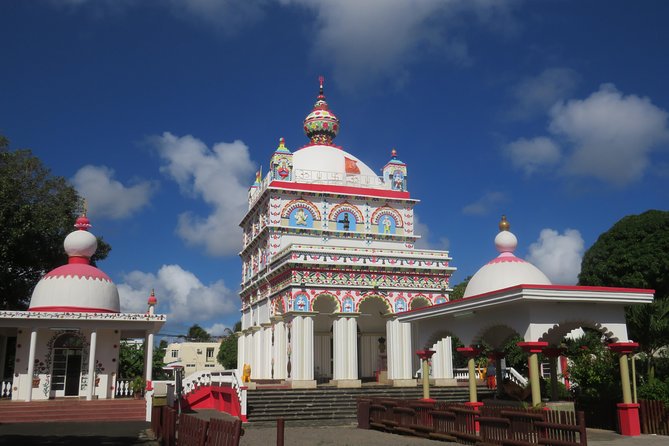
The first stop is the temple at Triolet, where the first Maha Shivaratree pilgrimage in Mauritius began in 1898. That date gives the visit a concrete link to the island’s religious past rather than presenting Hinduism as a recent or imported feature of modern Mauritius.
You spend about an hour here, the longest stop of the morning. That extra time should help you understand the site, its main deities, and the role of pilgrimage. The visit is not just a short look inside a building. It is the place where the tour’s larger themes begin: belief, public celebration, memory, and community.
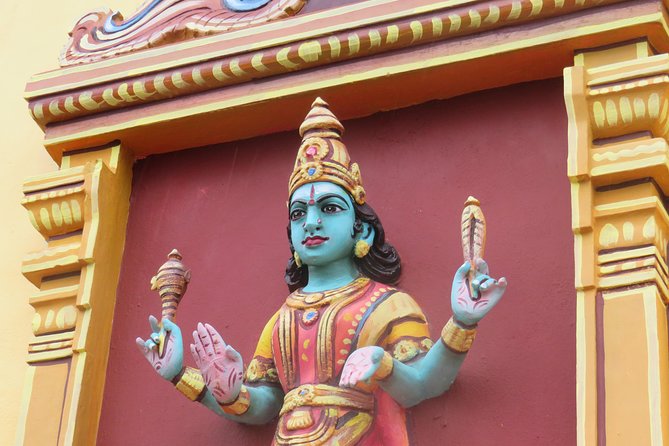
Maha Shivaratree is associated with Shiva, and the guide uses questions about the deity to explain key ideas. You may hear why Shiva is shown with a blue neck and why a lingam should be kept watered. These details are valuable because they turn unfamiliar images into stories with a purpose.
The lingam is particularly important for first-time visitors. Without explanation, a lingam can be difficult to interpret. The constant watering is not a decorative habit, and the tour promises to explain why that action matters within worship.
Admission is free at this stop, as it is at the other listed temple visits. That does not mean the site is without value. Religious places often reward patience more than a hurried checklist, and an hour allows the guide to place what you see into a wider setting.
The tour also links the temple to the history of slavery and the experience of Indian communities in Mauritius. The supplied details do not set out every historical point, so you should think of the visit as an introduction rather than a full academic history lesson. Still, that connection makes the temple more meaningful than an isolated religious monument.
Cap Malheureux and the first Tamil kovil
The second stop takes you to Cap Malheureux for a Tamil temple, known as a kovil. You spend about 30 minutes here, with attention to its description, history, legends, and myths.
This is where the tour broadens beyond one religious tradition. Hindu practice in Mauritius is not one single block, and the Tamil focus gives you a chance to see how language, community identity, and worship can overlap.
The distinction between Hindu and Tamil religion can be confusing if you are new to the subject. The tour raises that question directly rather than pretending that labels are simple. Tamil religious practice can include Hindu deities and wider cultural traditions, while Tamil identity also carries its own language and community history.
The promised legends and myths should make this stop accessible. I like that wording because it leaves room for different kinds of stories. A myth is not presented as a dry historical fact, and local legend can reveal how a community understands a place.
Thirty minutes is enough for a focused explanation, but it is also the point where you should keep your expectations realistic. This is not a long study visit with time for every architectural detail. The value comes from the guide’s interpretation and from seeing a Tamil place of worship within its own Mauritian setting.
The temple is in Cap Malheureux, so the morning moves between nearby northern sites rather than sending you across the island. That keeps the three-hour schedule practical. It also means the experience is a good match for someone staying around Grand Baie who wants a cultural morning without committing to a full-day excursion.
The 15-meter Muruga statue
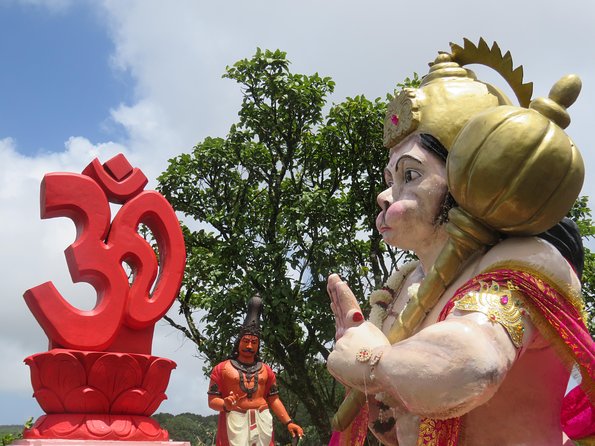
The third stop is another Tamil temple in Cap Malheureux, where you can see an imposing statue of Muruga measuring 15 meters high. It is described as a replica of the statue at the entrance to Batu Caves in Kuala Lumpur.
You spend about 15 minutes here. That is brief, but the scale of the statue gives the stop an immediate visual focus. Muruga is not introduced as a minor decorative figure. The statue provides a clear example of how Tamil religious identity can be expressed through large public imagery.
The comparison with Batu Caves gives the statue extra context. If you know the Kuala Lumpur landmark, the connection will be especially easy to grasp. If you do not, the guide can still explain why Muruga is important and how this Mauritian statue relates to a well-known Tamil religious site elsewhere.
This stop is likely to be the most photograph-friendly part of the route, but it should not be treated as only a photo opportunity. The statue works best when you understand the deity and the community traditions behind it.
Fifteen minutes also shows how the tour is paced. Triolet receives the detailed treatment, the first Cap Malheureux temple adds history and legend, and the Muruga statue delivers a concise visual finish. You get variety without stretching the morning beyond its promised duration.
A completely different kind of day in Port Louis:
- Port Louis: Street Food & City Tour
★ 4.9 · 377 reviews - Port-Louis Street Food Tour
★ 5.0 · 264 reviews - TAXI north guided tour.
★ 5.0 · 171 reviews - Mauritius: Port Louis and Northern Highlights Full-Day Trip
★ 4.3 · 161 reviews
Festivals that give the route its wider meaning
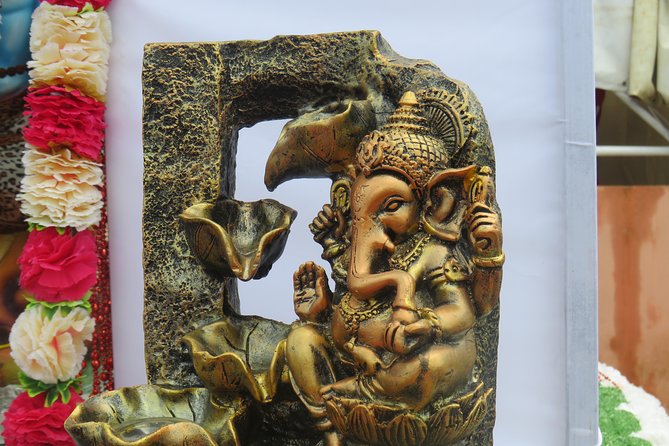
One of the strongest parts of this experience is its attention to festivals. The guide discusses Maha Shivaratree, Cavadee, Ganesh Chaturti, Ganga Snan, and Govinden, asking what each event celebrates and how it is practiced.
You should not assume every festival will take place during your visit. The tour offers the possibility of attending or following processions or prayers on specific festival dates. If your trip lines up with one of those dates, ask about the current arrangements before booking or shortly after confirmation.
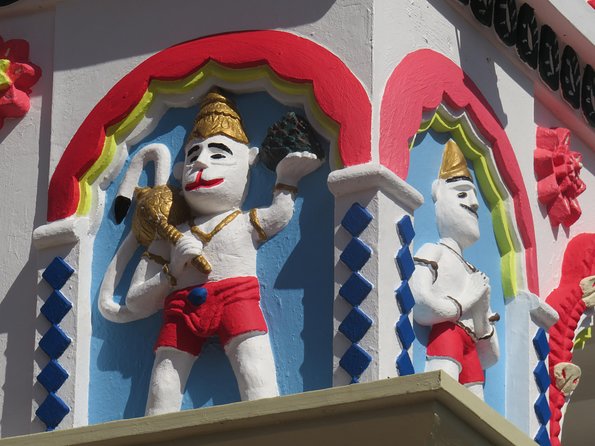
Maha Shivaratree connects directly to the Triolet pilgrimage. Cavadee and Govinden bring Tamil religious practice into the discussion, while Ganesh Chaturti focuses attention on Ganesh. The story of Ganesh’s broken right tusk is one of the memorable examples promised during the tour.
Ganga Snan adds another layer by pointing to ritual bathing and the importance of sacred water. The supplied details do not specify exactly how this festival will be presented on your date, so treat it as a subject for explanation rather than a guaranteed event.
The festival discussion matters because religion in Mauritius is public as well as private. Processions, prayers, and shared celebrations show how belief becomes part of community life. You get a clearer sense of the connection between a temple and the wider society around it.
This is also the part of the experience most likely to change with timing. A normal temple visit follows the listed route, while a festival date may offer a different rhythm or added activity. Confirm the details before relying on a procession as the main reason for your booking.
Eric’s guiding style and the value of a private group
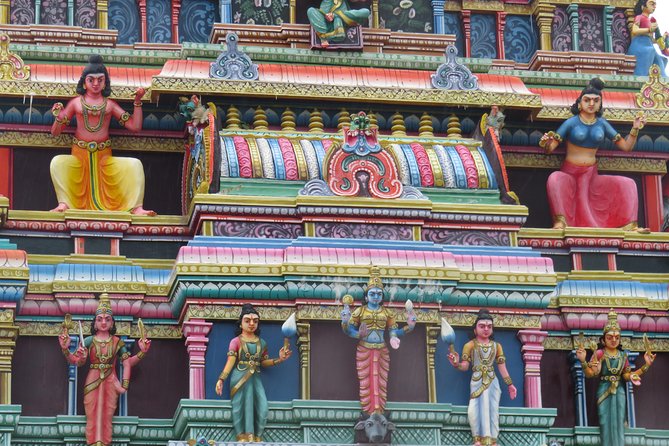
The only named guide feedback identifies Eric and praises his detailed explanation of Hindu religion, history, and the region. The comment also points to his extensive local knowledge and strongly recommends the tour for people interested in the subject.
That praise fits the design of the experience. Three temples alone do not make a strong tour. The quality depends on whether the guide can explain symbols, local history, and religious practice without flattening them into a list of facts.
Eric’s approach appears to be especially useful for curious beginners. You can ask basic questions about Shiva, Ganesh, Muruga, or the lingam without needing prior study. At the same time, the festival and historical material gives more experienced visitors something to discuss.
The private format should help the conversation feel natural. A family, couple, or small group can set the pace within the fixed three-hour window. You can spend more time on a question that interests you, although the provided information does not guarantee that every stop can be extended.
The tour is operated by Moris Otreman. Confirmation is received when you book, and the activity uses a mobile ticket, which keeps the admission process simple.
Price, timing, and practical fit
At $64.61 per person, this is not the cheapest way to spend three hours in Mauritius, but the comparison should be made with private guided activities rather than with a free temple visit. The price includes the value of a dedicated guide, a planned route, historical interpretation, and a small-group setting for your own party.
Admission to the listed temple stops is free. That makes the guiding and transport structure the main part of what you are paying for. If you only want to look at the temples, you may find the price hard to justify. If you want to understand what you are seeing, the cost is more reasonable.
The experience is booked, on average, about 40 days ahead. That does not guarantee that every date sells out, but it is a useful planning signal. If your holiday dates are fixed, booking early makes sense, especially if you want to match the tour with a particular festival.
Start time is 9:00 a.m. at La CroisetteMU, Chem. Vingt Pieds, Grand Baie 30517. The tour returns to this same meeting point, so you should plan your morning around Grand Baie rather than assume a hotel drop-off elsewhere.
The tour lasts approximately three hours. Its northern route makes it a manageable cultural outing, but you should not expect a full island tour. The activity requires good weather, and if poor weather causes cancellation, you are offered another date or a full refund.
Most participants can take part, and service animals are allowed. The activity is near public transportation, though the supplied details do not specify routes or travel times. Check your exact meeting plan before the morning begins.
Free cancellation is available up to 24 hours before the start time for a full refund. Changes or cancellations made less than 24 hours before the start are not accepted for a refund, and local time controls the cutoff.
Who should book this experience
I would choose this tour if you want cultural context with your Mauritius holiday. It suits people who enjoy asking why a ritual exists, how a symbol developed, and how religious practice connects to local society.
It is also a good fit for visitors staying near Grand Baie who want a short morning activity. The 9:00 a.m. start and return to La CroisetteMU make the plan easy to place before a later meal or another northern outing.
Families and small private groups may appreciate the format. The playful questions about Shiva, Ganesh, and the lingam can help younger visitors stay interested, though the supplied information does not specify a minimum age or child program.
I would hesitate if your main goal is architecture, shopping, or scenery. The temples are the center of the morning, and the tour’s strongest feature is the explanation around them. It is also not the right choice if you need guaranteed festival participation on any ordinary date.
Should you book Route of Indian Spirituality?
Book it if you want to understand a side of Mauritius that beaches cannot explain. The combination of Triolet’s 1898 pilgrimage connection, two Tamil temples in Cap Malheureux, the 15-meter Muruga statue, and clear explanations of Hindu symbols gives the morning a strong sense of purpose.
The best reason to book is the guide-led interpretation, especially if Eric is leading your visit. The main caution is scope: three hours covers one subject well, not the whole island.
If your dates match Maha Shivaratree, Cavadee, Ganesh Chaturti, Ganga Snan, or Govinden, ask about joining a procession or prayer. Otherwise, book this as a focused private introduction to Indian spirituality and Mauritian history, not as a general sightseeing tour.
FAQ
Where does the tour start?
It starts at La CroisetteMU, Chem. Vingt Pieds, Grand Baie 30517, Mauritius.
What time does the experience begin?
The start time is 9:00 a.m.
Where does the tour end?
The activity ends back at the meeting point at La CroisetteMU.
How long does the tour last?
The tour lasts approximately three hours.
How much does the experience cost?
The listed price is $64.61 per person.
Is this a private tour?
Yes. Only your group participates in the activity.
Which temples are included?
The route includes the temple at Triolet, a Tamil temple in Cap Malheureux, and a second Tamil temple in Cap Malheureux with a 15-meter Muruga statue.
Are admission fees included?
Admission to the listed temple stops is free.
Can I attend a religious procession or prayer?
The experience offers the possibility of attending or following processions or prayers on specific festival dates. Availability depends on the date of your visit.
What happens if bad weather cancels the tour?
You can be offered a different date or a full refund if poor weather causes cancellation. Free cancellation also applies when you cancel at least 24 hours before the start time.
New in Port Louis this month
- Cultural Delights & Heritage Treasures in the City★ 5.0 · 3 reviews
- Insta-Worthy City Tour: Unveil Picture-Perfect Spots★ 5.0 · 3 reviews
- Mauritius Private South West Tour★ 5.0 · 3 reviews
- North Tour Of Mauritius With Street Food tasting★ 5.0 · 3 reviews
- Port Louis: City Tour with Street Food Tasting★ 5.0 · 3 reviews
- 1 way Airport transfer★ 4.0 · 3 reviews
- Southern Mauritius: Volcanoes & Coloured Earth★ 5.0 · 3 reviews
- Creole Culinary Workshop★ 5.0 · 3 reviews
Port Louis Tours, compared.
Mauritius North: Private Paradise Tour with Gardens, Markets
Read our review →
Port Louis and Northern Highlights Full-Day Trip
Read our review →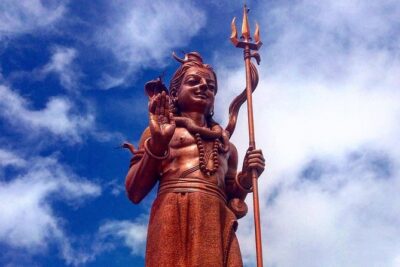
Enchanting South of Mauritius: Full-day tour Incl CASELA Park, Lunch & Transfer
Read our review →Browse the lists this tour appears in